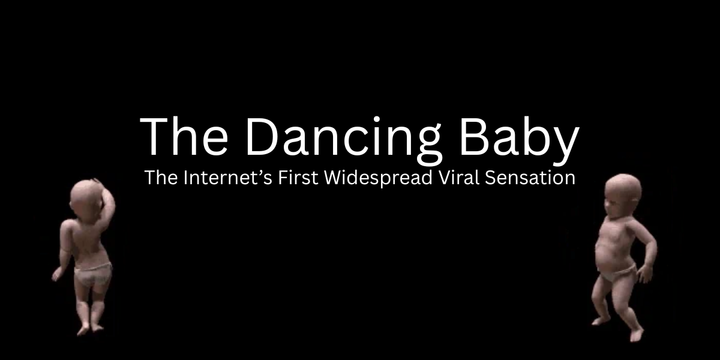
The Dancing Baby: The Internet's First Widespread Viral Sensation
Archive Entry: 002
Type: Meme History
Published: March 17, 2026
Note from the Archivist: In elementary school, I learned how to use the family printer - but more importantly, I learned that I could copy images off of the internet into paint and press print. Of course, buried amongst random RuneScape assets, was a still of the Dancing Baby, printed off and presented to my peers as a work of art.
Before TikTok dances and viral challenges became a marketing category, a bizarre, diaper-clad 3D baby started doing the cha-cha. If you were online in the late 90s, the Dancing Baby was inescapable. It appeared in email forwards, on early personal websites, and eventually on prime-time television. Its journey from a curious technical demo to a global cultural phenomenon defined what "viral" meant for a generation, long before algorithms took over.
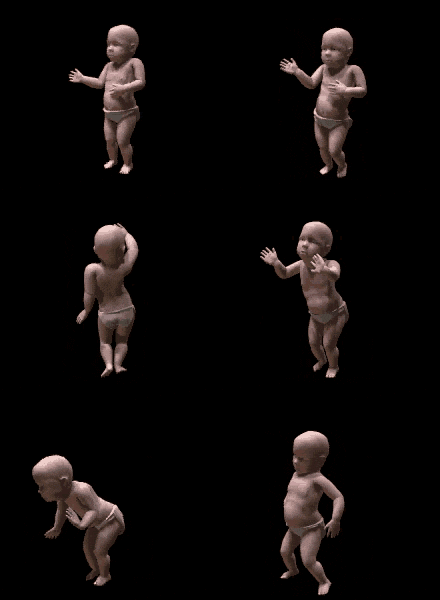
Its story began in 1996, in the then-niche world of 3D animation software. Kinetix, a division of Autodesk, released Character Studio 1.0, a suite of tools designed to simplify the animation of human-like figures. Buried within its sample files was sk_baby.max, an animation crafted by Michael Girard, Robert Lurye, and John Chadwick. They took a generic 3D model, "Toddler with Diaper" from Viewpoint Datalab, and, in a moment of either accidental brilliance or deadpan humor, rigged it to perform a surprisingly fluid cha-cha. Robert Lurye later confessed, "babies are not supposed to move this way," encapsulating the unsettling charm that would soon captivate millions. Michael Girard recalled that upon seeing it, he, Robert, and John "realized they really had something," noting it was a "striking" example of their new animation techniques, even if they "wouldn't have anticipated that it would have spread the way that it did."
Then came Ron Lussier, a LucasArts animator and an early enthusiast of Character Studio. He discovered sk_baby.max and, much like the rest of the nascent online world, found it both unsettling and hysterically funny. Lussier made minor tweaks, adjusting the camera angle, and then did what any good internet citizen of 1996 would do: he shared it. First as an .avi file on a CompuServe Internet forum, then by email to his colleagues. That act kicked off the first documented instance of something spreading purely through decentralized, peer-to-peer digital word-of-mouth, years before any platform formalized that behavior into a button.
The real shift came when web developer John Woodell got his hands on the .avi. In 1996, the internet was a slow, dial-up affair where even short video files represented massive downloads that could tie up a phone line for hours. Woodell made a pivotal decision: he converted the animation into a highly compressed animated GIF. Suddenly the Dancing Baby could be embedded directly into web pages, loaded relatively quickly on sluggish connections, and shared with unprecedented ease across a bandwidth-starved internet. The GIF made the Baby ubiquitous and accessible, transforming it from a niche tech curiosity into a broadly consumable cultural artifact.
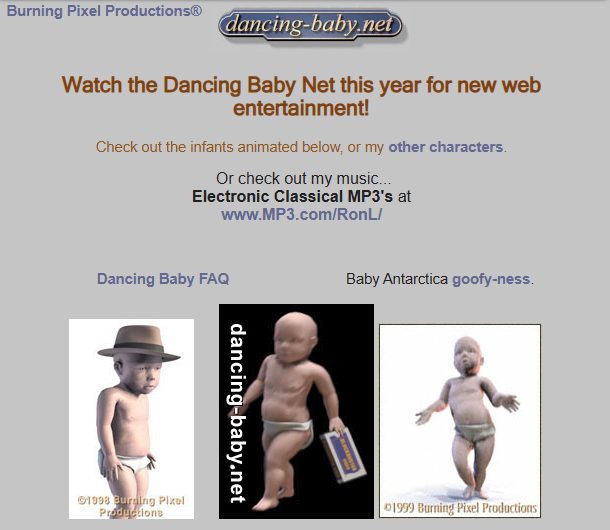
By 1997, the Dancing Baby was everywhere. Rob Sheridan, an artist and web developer, launched "The Unofficial Dancing Baby Homepage," which rapidly became a community hub where users shared remixes and variations. Among these, the "Oogachacka Baby" stands out which paired the animation with Blue Swede's "Hooked on a Feeling." This was an early, organic explosion of user-generated content and participatory culture, all coalescing around a weird, cha-cha-ing infant. In a Know Your Meme interview, Girard reflected that the Dancing Baby relied, like most memes, on the collective creative contributions of multiple artists who picked up the original files and ran with them.
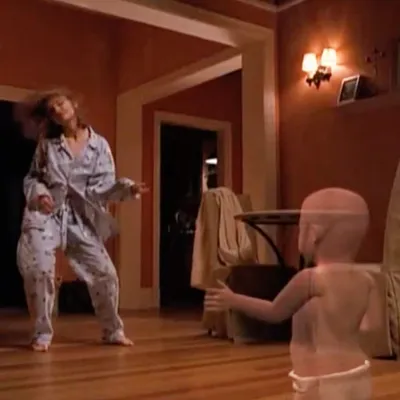
The Dancing Baby's leap into mainstream cultural icon status came in 1998, thanks to David Kelley, the creator of the hit TV series Ally McBeal. Kelley openly acknowledged his inspiration from the online phenomenon and incorporated the baby as a recurring hallucination for the titular character, Ally, materializing at moments of stress, confusion, or longing for motherhood. A weird .avi from a software demo package was now appearing weekly on Fox prime-time. The migration from CompuServe forum to network television had taken about two years and cost nobody a marketing budget. Girard described the moment the scale finally registered:
"The phones were ringing off the hook at Autodesk, who published our software, and I was asked to be in several interviews. I remember the headline across USA Today included renderings of the Dancing Baby across its front page."
In 2022, Michael Girard, Robert Lurye, and John Chadwick digitally restored and re-rendered the Dancing Baby in high definition, a testament to its enduring legacy. Girard expressed his satisfaction with the restoration, noting, "the HD digitally restored baby that resulted is...what I think we're the proudest of because it reveals the details of the Dancing Baby's facial features and body shape with much more clarity and beauty."
The Dancing Baby was a blueprint for how internet culture would operate for the next three decades. An unsettling technical demo became a global sensation through decentralized sharing, a format hack, and collective creative remixing with no corporate marketing, no algorithm, no platform push. Every meme that followed used some version of the same playbook. The weird baby just got there first, as Girard reflected, serving as an early symbol of "our hopes and dreams of what internet culture might become in the future."
Sources
- https://en.wikipedia.org/wiki/Dancing_baby
- https://knowyourmeme.com/memes/dancing-baby
- https://amp.knowyourmeme.com/editorials/interviews/dancing-baby-creator-michael-girard-discusses-designing-the-first-internet-meme-26-years-after-it-swept-the-web-via-email-chains
- https://www.cnn.com/2022/05/05/tech/dancing-baby-nft-internet-culture-trnd/index.html
- http://www.dancing-baby.net/BabyFAQ.htm
- https://mentalfloss.com/article/661852/dancing-baby-cha-cha-meme-ally-mcbeal-history